The path to the NV master recipe
Instead of running isolated lab batches for years, we build the master recipe on a data foundation of 10 000–15 000 producing reactors — each running multiple growth batches per year, fed by the fleet of our partner Vallabhbhai Patel in Surat and Mumbai. A digital twin learns the coupling between plasma, gas chemistry and geometry; our in-line metrology then runs the finished recipe in milliseconds on every reactor.
Existing reactors are retrofitted with our metrology — new SURAT-7B reactors ship fully instrumented from day one.
The Surat / Mumbai diamond hub runs hundreds of HPHT and MPCVD reactors today — most of them without in-line diagnostics. We install the identical metrology package into every delivered and every retrofitted reactor: NanoZ MOx array (H₂/CH₄/trace), ThermoAir 5.0 mass-flow, multi-channel pyrometry, plasma OES (H_α/C₂/CH), chamber pressure, substrate T. Every reactor becomes a data sensor — while remaining in full production for the partner.
10 000–15 000 reactors · multiple runs each per year — a six-figure data base per year into the TSR cloud (Switzerland).
The Vallabhbhai Patel fleet covers 10 000–15 000 producing reactors across Surat and Mumbai. Every reactor runs multiple growth batches per year, which streams a six-figure count of fully instrumented growth runs per year into the TSR cloud, each at second-level resolution across every sensor, plus gold-standard labels (Raman / XRD / ODMR) at the end of every run. Data residency Switzerland, ISO 27001-grade pipeline. Raw process data stays partner-owned; derived models stay TSR-owned.
AI learns the coupling plasma ↔ gas chemistry ↔ geometry ↔ crystal quality.
A hybrid model combining physics-based MPCVD equations (plasma Boltzmann, gas-phase kinetics, heat balance) with data-driven correction (XGBoost / Gaussian Process / 1D-CNN over time series) represents every reactor as its own digital twin. The model predicts growth rate, crystal quality and — most importantly — the NV center yield from setpoint trajectories, with a confidence interval per run.
The master recipe for NV-grade diamond is found in weeks, not years.
With a trained digital twin, recipe optimization runs as Bayesian optimization / reinforcement learning in silico — thousands of virtual runs per hour, instead of one real run per day. Convergence on an NV-optimized master recipe (targeted [N] doping, ¹²C enrichment, vacancy engineering via pressure/power modulation) within an estimated 8–16 weeks — versus the 3–5 years of classical single-lab DoE iteration.
TSR metrology closes the loop — setpoint correction in < 10 ms.
Once the master recipe is locked, it doesn't run as a static table but as a closed-loop trajectory: NanoZ MOx delivers ppb-grade gas composition (T₉₀ < 1 s), ThermoAir 5.0 measures mass flow at 0.5 % accuracy (ms-grade resolution), OES and pyrometry close the plasma/temperature picture. The Beckhoff PLC tick runs at 1 ms, MFC setpoint updates land in under 10 ms. Every drift in the plasma chemistry is corrected before the crystal even sees it — that's what makes the master recipe reproducible from reactor to reactor.
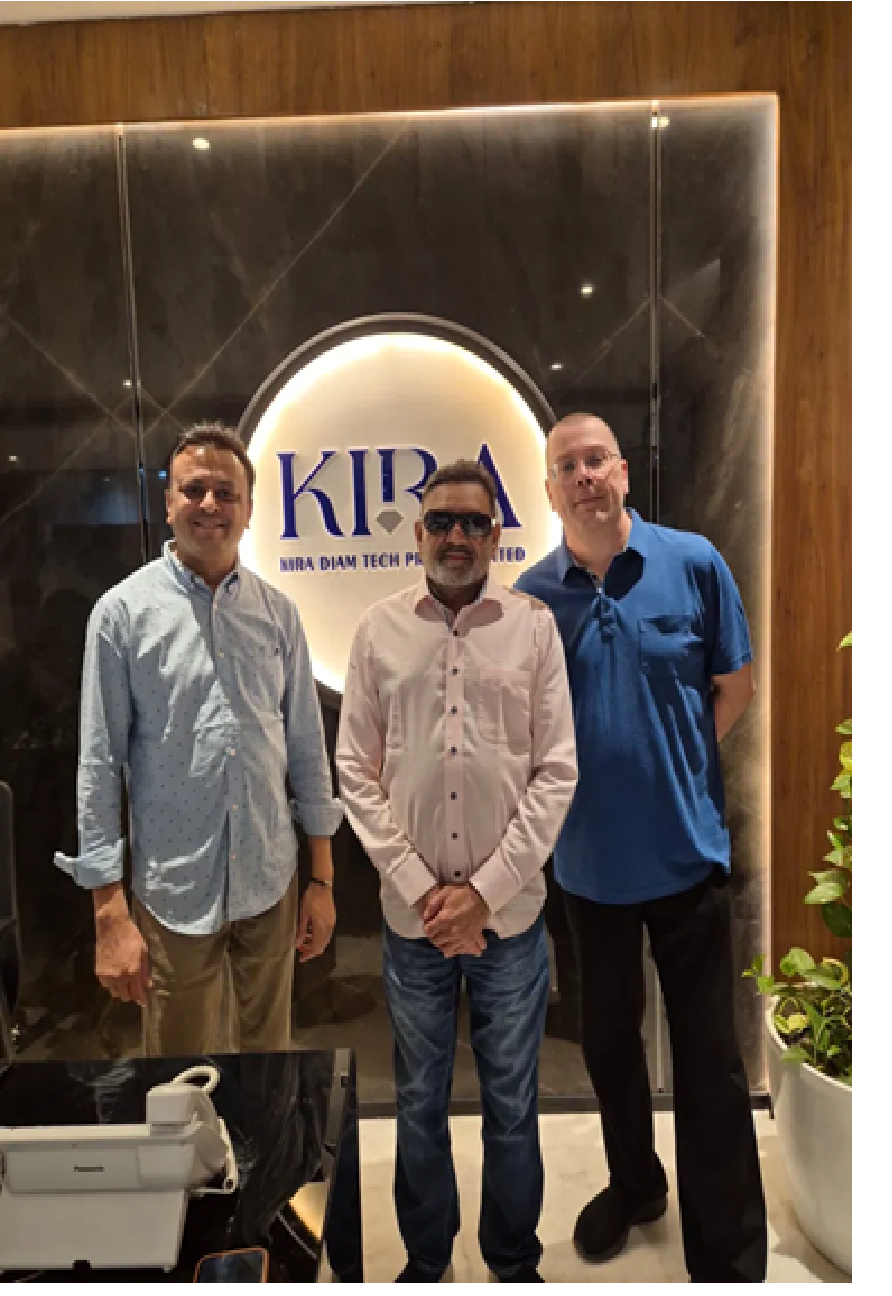
Kira Diamonds, Surat · 30 January 2026
Working meeting — left to right: Jayesh Savalia (Co-Owner, TSR AI NANOZ Sensors Pvt. Ltd.), Vallabhbhai Patel (Owner, Kira / Kiran Diamonds) and Michael Scheller (CEO, TSR Messtechnik AG) at the reception of Kira Diamonds Pvt. Ltd. in Surat. Agenda: retrofit strategy for the existing reactor fleet, the data-sharing model for the digital twin, the scale-up path for SURAT-7B inside the Patel group and the NV-substrate distribution channel through the Kiran Diamonds network in Mumbai.
Vallabhbhai Patel
Owner of Kira Diamonds Pvt. Ltd. (Surat, Gujarat) and Kiran Diamonds (Mumbai, Maharashtra) — one of India's largest vertically integrated diamond houses, covering rough sourcing, HPHT/MPCVD synthesis, cutting, polishing and end-customer distribution under one roof.
- ▸Access to a producing reactor fleet in Surat (hub of the global diamond industry) and Mumbai — on the order of 10 000–15 000 reactors.
- ▸Live production data under real conditions (45 °C, 90 % RH, tropical climate, Indian grid quality) — no lab bias.
- ▸Gold-standard characterization of every run (Raman, XRD, optical inspection) through Vallabhbhai Patel's in-house lab — paid ground-truth labels.
- ▸Distribution channel for NV substrates the moment the master recipe is ready — Vallabhbhai Patel knows every jewellery, optics and quantum customer in the Indian and global market.
- ▸Make-in-India compliance built in (DVA ≥ 40 %, PLI eligibility) — production stays in Gujarat.